Monday, December 3, 2012

Chelsey Tyler Wood

I love these works because they seem kind of in-your-face.
Her drawings have a lot of realism and the dark contours of the surrounding shadow bring to mind cartoon-like outlines. 

Her paintings are similar to her drawings but incredibly realistic and detailed. they show chelsey tyler wood to be meticulous and disciplined.


It especially delights me that she has an interest in painting non-idealized female nudes. She makes a body type that is normally frowned upon in our current society into something beautifully relatable.

Gabriel Dawe

http://www.gabrieldawe.com/

graphic designer turned installation artist

famous for his site-specific installations made from different colors of thread.
the shapes and colors created make for really fascinating, multi-dimensional pieces that i think are curiously beautiful. they seem so simplistic but unattainable at the same time.


he also has works on fabric (also in thread, of course):


this is his self portrait:

his art has a hand in fashion, and i like the subtleties of his message. his art speaks to the perception of masculinity and machismo, but in a way that i think is really accessible. 


Gaston Lachaise

born 19 march 1882
died 18 october 1935

Sculptor who worked mostly in bronze.
He was trained in decorative arts in France under a famous jewelry maker, and it wasnt really until his emigration to the United States in 1906 that he began sculpting on a large scale.

He is very well known for his depictions of women, which helped redefine the female nude. His depict a strong, voluptuous image with large curves and tapering limbs. I love that he seems to idolize what makes a female nude feminine in a time during which boyishness was a desired trait (I'm thinking of the flapper style that was popular when Lachaise created Woman Standing)

He was also known as an exceptional portraitist in marble and other mediums:
Georgia O'Keefe
 e e cummings


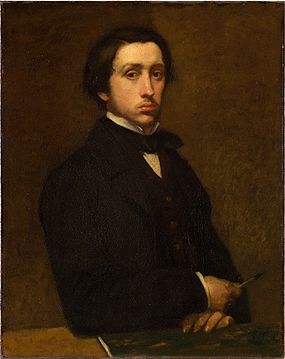
Edgar Degas


Hilaire-Germain-Edgar De Gas, French
born 19 july 1834
died 27 september 1917

Although he is credited as helping found Impressionism, he hated the term and preferred to be labeled a Realist. He is renowned for his paintings, sculptures, drawings and prints.
Over half of his works depict dancers.
He has a great use of color and a great eye for perfectly capturing light.
I have great respect for his talent in pastels.

Degas enjoyed sculpting in wax, and many bronzes were made from his sculptures after his death.
Little Dancer, aged fourteen is one of Degas' most famous works, in part because he sculpted it not only out of wax but with a real bodice and tutu, and a wig of real hair, all of which he covered in wax.


Jeff Soto

http://www.jeffsoto.com/art.html
Pop Surrealist and Street Artist
calls himself “a muralist with an occasional urge to do some graf”.
heavily influenced by illustration. he majored in it at Art Center College of Design.
his works are detailed and ethereal. i love how he mixes elements of illustration with painting, and his use of color is intense but calming.


Thursday, November 29, 2012

Seven Days in the Art World Discussion Questions

The Auction House

1. Is it more valuable to one's career as an artist to have a dealer or to sell for themselves at an auction?

2. Ségalot claims that art buying is a conquest, "an extremely satisfying, macho act" (p11). Bidding styles were compared to sexual performance (p32). Keith Tyson referred to the mental process of bidding as an "alpha-male mentality" (p37). Does that imply that the act of making the art is not seen as macho? 
This question especially interested me, given that throughout history art has been seen as a macho thing, a male-dominated field in which women are only recently accepted and involved (and some people think that women artists are still not on equal footing with male artists).

3. Sarah Thornton says that "many of the artists who sell well at auction are artist/entrepreneurs" (p38). When I think of an entrepreneur, I think of someone who is trying to sell what or who he is to others. Yet, according to Keith Tyson, "art is trying to sell you yourself" (p37). Is it more one or the other, or is an artist trying to sell you herself while showing her art is meant to have personal meaning to you? Is the personal meaning just a happy byproduct? 

The Crit

1. Mary Kelley stops interpretation in her crit class when she thinks "we might be going too far." If one is pulling meanings and references that the artist didn't intend, how do you know where too far is?

2. Is there a way to truly define an artist these days that would not be circular?

The Fair

1. It was important both to buyers and sellers at the art fair that none but those involved know who bought what until officially published, at which time the amount would sometimes be inflated. It was taboo to ask, unlike at the auction where the prices of works are very public. Why is the mentality at the fair so different from that at the auction?

The Prize

The Magazine
1. Every position around the art world is definable. Critic, collector, curator, dealer, editor, writer, etc. Why is artist so hard to define that it is defined circularly? (i.e. an artist is someone who makes art)

2. "Nowadays most of Paula Cooper's ads contain no image" p177. In a world that often relies heavily on images, is it more or less effective to advertise with images?

The Studio Visit

1. Sarah Thornton makes a point of mentioning the corporatization of Japan within Murakami's roots. Is it common for artists to base themselves through a corporation, or is it purely because of Murakami's roots that he is?

The Biennale

1. I found it interesting that within this chapter there were some that lamented the nationalism of the various countries' booths, and some that lamented the global homogenization of art. Is a having sense of national identity important to being an artist?

2. Does having a government support an artist's work (as opposed to personal funding or other financial backing) contribute to the country's exhibit/building having a more pronounced national identity?


Sunday, November 18, 2012

Chapter 3 Discussion Questions

1. Robert Hughes, when criticizing Jenny Holzer's work, calls it "limpidly pedestrian" and that it makes no demands on the viewer. What does he mean by that? How much demand must it make to be art? Does he presume to say that should it make no demands, or not the right kind of demands, it cannot be art?